Quick Answer: Determine your 1-rep max by either testing it directly with a warmed-up heavy single, or estimating it from a submax set using a formula like Epley or Brzycki. Once you have the number, apply it to your program’s percentages, then keep it updated as your strength changes.
Ready-made percentage programs
- 5/3/1 Boring But BigFour days a week, a 4-week wave on each main lift, then 5 sets of 10 at 50%.
- nSuns 5-DayFive days a week, higher volume, with the max raised every week.
Every week’s percentages and “+” sets, ready to track in the TRY Fitness app.
A calculator can give you a number in two seconds. The harder part is turning that number into the actual weight you load on the bar every week for the next three months. That’s where most 1RM tools stop, and where percentage-based programs like 5/3/1 or nSuns start asking more of you.
5/3/1, created by strength coach Jim Wendler, is a structured strength program built around sets of 5, 3 and 1 reps across different training weeks. nSuns is another popular strength program inspired by 5/3/1, generally known for its higher training volume and more frequent progression. Both use percentages of a training max to determine your working weights.
If you’re following a program like these, knowing your 1RM is only the starting point. You also need to understand how to turn it into a training max, calculate your working weights, and update those numbers as you get stronger.
How to Calculate Your 1-Rep Max
You calculate your 1-rep max either by testing it directly or by estimating it from a lighter set.
To test it, warm up with several progressively heavier sets, then add weight in small increments until you reach a single rep you can complete with good technique. A common rule of thumb is to rest about 3–5 minutes between heavy attempts.
Here’s a basic warm-up and testing sequence for a lift like the squat or bench:
- 50% of your estimated max for 8 reps
- 70% for 3 reps
- 85% for 1 rep
- 90% for 1 rep
- 95% for 1 rep, if the previous attempt was comfortable
- Attempt your estimated maximum, then increase in small increments if successful
These percentages are starting points, not a fixed testing protocol. Adjust the jumps based on your experience, the lift, and how the previous set felt. Use a spotter or appropriate safety equipment when testing lifts such as the bench press and squat.
Testing a true max works best on lifts you’ve practiced consistently and can perform with good technique. If you’re still learning a movement, estimating from a lighter, controlled set is generally a better option than attempting an all-out single.
1-Rep Max Formulas
The two common formulas used by a one-rep max calculator are Epley and Brzycki. Both estimate your maximum from the weight you lift and the number of repetitions you complete, but they can return different results.
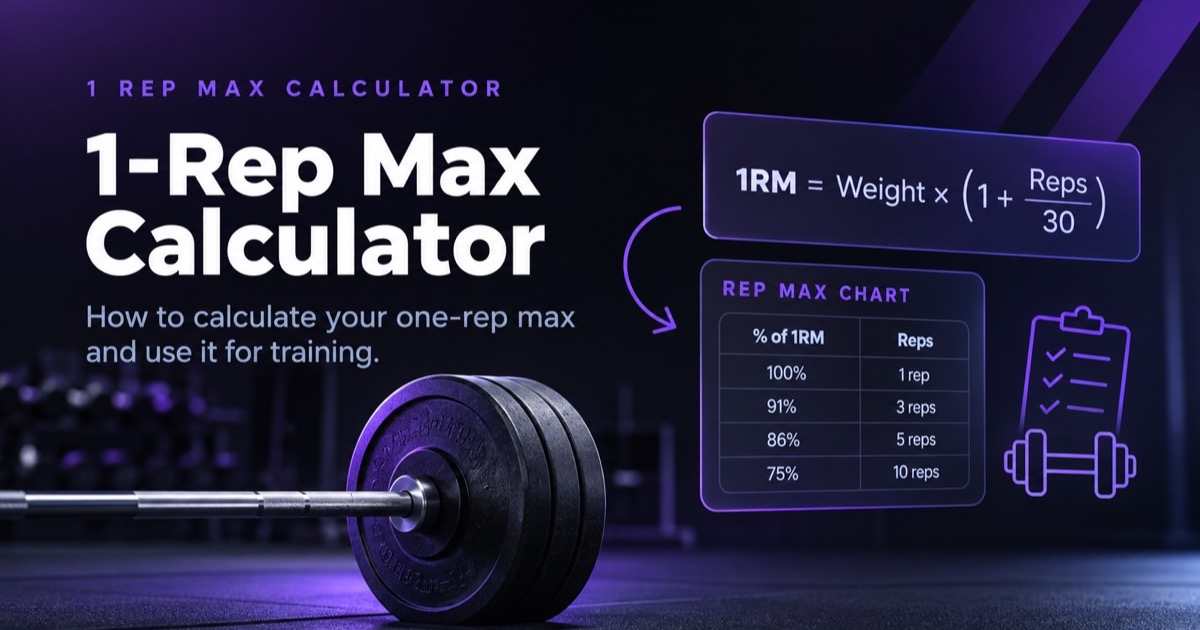
Epley formula: 1RM = Weight × (1 + Reps / 30)
Brzycki formula: 1RM = Weight × 36 / (37 − Reps)
For example, say you bench press 185 lbs for 5 reps.
| Formula | Calculation | Estimated 1RM |
|---|---|---|
| Epley | 185 × (1 + 5/30) | 216 lbs |
| Brzycki | 185 × 36/32 | 208 lbs |
Both formulas provide estimates, not verified maximums. As you can see, they can produce different results even with the same weight and rep count.
Their estimates also become less dependable as the number of repetitions increases, particularly when the set isn’t taken close to failure. This is why 1RM calculators are generally more useful with lower-repetition sets, commonly around 3–10 reps.
A one-rep max calculator simply puts these formulas into a form where you enter your weight and repetitions instead of doing the math yourself. The important part is using an honest weight and rep count from a real set performed with consistent technique.
Estimating vs. Testing Your Max
Estimating your 1-rep max from a submax set is usually the better choice unless you have a specific reason to test a true max, like a powerlifting competition.
A set of 3–5 reps taken close to failure can provide a useful estimate without the fatigue and setup time of a full max-out session. The closer the set is to your actual rep limit, the more useful the estimate tends to be.
Test directly when you need a verified number for competition, or when you’ve plateaued and want to confirm your training max is still accurate. Estimate instead when you’re midway through a training program and simply need updated numbers for your working sets.
The best approach also depends on your experience:
- Beginners: Estimate from a controlled set rather than attempting a true maximum, especially while learning proper technique.
- Intermediate lifters: Use submaximal sets to reassess strength periodically as your working weights improve.
- Experienced strength athletes: Test a true 1RM when preparing for competition or when a verified maximum is useful for programming.
Watch Out: Estimating from a set taken well short of failure skews your number high. If a “5-rep set” actually had 3 reps left in the tank, your estimated max will be inflated and your training percentages will run too heavy.
Before you build percentages around any max, check whether the program structure itself makes sense. The Free Program Analyzer gives a structural breakdown of any program, free, with no account.
Max Rep Chart by Reps
A max rep chart lets you estimate your 1RM from a weight you can lift for multiple repetitions without having to run a formula every time.
The following percentages are approximate and follow the Epley relationship (1 ÷ (1 + reps/30)):
| % of 1RM | Reps Typically Possible |
|---|---|
| 100% | 1 rep (1RM) |
| 91% | 3 reps (3RM) |
| 86% | 5 reps (5RM) |
| 75% | 10 reps (10RM) |
These percentages are estimates rather than universal standards. Your actual repetition capacity can vary depending on the exercise, training experience, and individual differences.
For example, to estimate your 10RM from your 1RM, multiply your 1RM by 0.75. To work backward and estimate your 1RM from a 10-rep set, divide the weight by 0.75.
Similarly, you can estimate your 1RM from a 5-rep set by dividing the weight lifted by approximately 0.86. These conversions are useful as a quick reference, but a formula-based calculator can give you a more precise mathematical estimate.
How Accurate Are 1RM Calculators?
A 1RM calculator gives you an estimate, not a guaranteed prediction of how much you can lift for one repetition.
Its accuracy depends on several factors:
- Formula used: Epley, Brzycki, and other prediction equations can return different results from the same set.
- Number of repetitions: Estimates generally become less dependable as repetition counts increase.
- Proximity to failure: A set performed well short of your maximum repetition capacity can inflate the estimated 1RM.
- Exercise selection: Prediction accuracy can differ between exercises such as the squat, bench press, and deadlift.
- Technique: Inconsistent form or changes in range of motion can affect the weight and repetitions used in the calculation.
For the most useful estimate, a common rule of thumb is to use a recent set of about 3–10 reps performed with consistent technique and close to your repetition limit.
If you need an exact competition number, a calculator cannot replace a properly conducted 1RM test.
Turning Your 1RM Into Training Percentages
Percentage-based programs like 5/3/1 and nSuns use your 1RM, or a training max derived from it, to calculate your working weights.
The distinction matters because many programs don’t use your full 1RM directly. Instead, they use a more conservative training max, which is a percentage of your actual or estimated maximum.
For example, the commonly used 5/3/1 setup starts with a training max of approximately 90% of your 1RM. The program then calculates working weights using percentages of that training max. Some variations use more conservative starting percentages.
nSuns also commonly uses a training max as the basis for its percentage-based working sets, although exact programming depends on the template.
TRY Fitness lets you run programs like 5/3/1 and nSuns. You give each main lift a training max (type it in, or start from TRY’s estimate). Each set is written as a percentage of that max, and TRY works out the weight for you, rounded to the plates you have. This is part of TRY Pro.
If you already have the program written down, you can paste it as text into Program Studio and TRY sets up its percentages, or build it there yourself. Either way, you then enter your maxes. Free members can log these programs, but the weight box shows the percentage, not the weight.
Two Ready-Made Percentage Programs
Each program below shows every day, lift and set, with each week’s percentages and “+” sets. You enter your training maxes when you start it in the TRY Fitness app.
- 5/3/1 Boring But Big: four days a week. Each main lift runs a 4-week wave with a “+” set on the top set, then 5 sets of 10 at 50% of your training max. The max goes up 5 lb (press, bench) or 10 lb (squat, deadlift) each cycle.
- nSuns 5-Day: five days a week, a heavy main lift and a lighter second lift each day. Each main lift’s max goes up every week from the reps on its “+” set. The second lift’s percentages are of the related main lift’s max, so give it that max.
Keeping Your Max Accurate Over Time
Your 1RM isn’t fixed. It changes as you get stronger, so a number from three months ago might no longer reflect what you can lift today. Re-estimating it every few training blocks helps keep your working weights relevant to your current strength.
TRY Fitness makes this easier to manage. In a percentage program, TRY Pro raises your training max at the end of each cycle by the program’s own rule: the same amount each cycle (5/3/1), from the reps on your “+” set (nSuns), or from a test day. For your other lifts, TRY Pro automates your progressive overload: your target weights and reps are built from your last workouts and updated after every workout. So instead of manually recalculating every time your strength changes, you get numbers that reflect how you’re actually training.
Pro Tip: Don’t let one bad session convince you that you’ve lost strength. Look at your performance across several workouts before changing your max estimate. Everyone has off days.
You can log your workouts and track your progress with the free version of TRY Fitness. If you want more guidance, Pro adds targets on every set, weights worked out for percentage programs, and strength trends to help you understand how your lifts are changing over time.
Give TRY Fitness a try if you’d rather spend your time lifting than doing the math behind every workout.
TRY Fitness is not affiliated with or endorsed by Jim Wendler.