Home › Features › Workouts and nutrition in one app
One app for tracking your workouts and your macros
You know the feeling of using two separate apps for your fitness? One is a workout tracker, but it doesn’t know that you’re cutting. And the other is a nutrition app, but it doesn’t show you how your strength has increased or decreased since you started bulking. You pay for both, you use both, but neither can exactly tell you the one thing you actually want to know — whether the way you’re eating is showing up in the gym.
TRY Fitness does both, properly. Not a workout tracker with a calorie field bolted on, and not a diet app that lets you tick a box saying you went to the gym — one app where your lifts and your macros sit in the same place.
This is the one! The one app that has everything I need. Solid workout tracking, solid nutrition tracking. Amazing analytics to help my progress. Seriously no need to look any further. Super affordable price for all that it has to offer.
With other nutrition apps, I’ve never been able to keep up with logging because it’s too tedious. But being able to speak my meal in generic terms just once or twice a day, without having to find each individual item, has made it so easy.
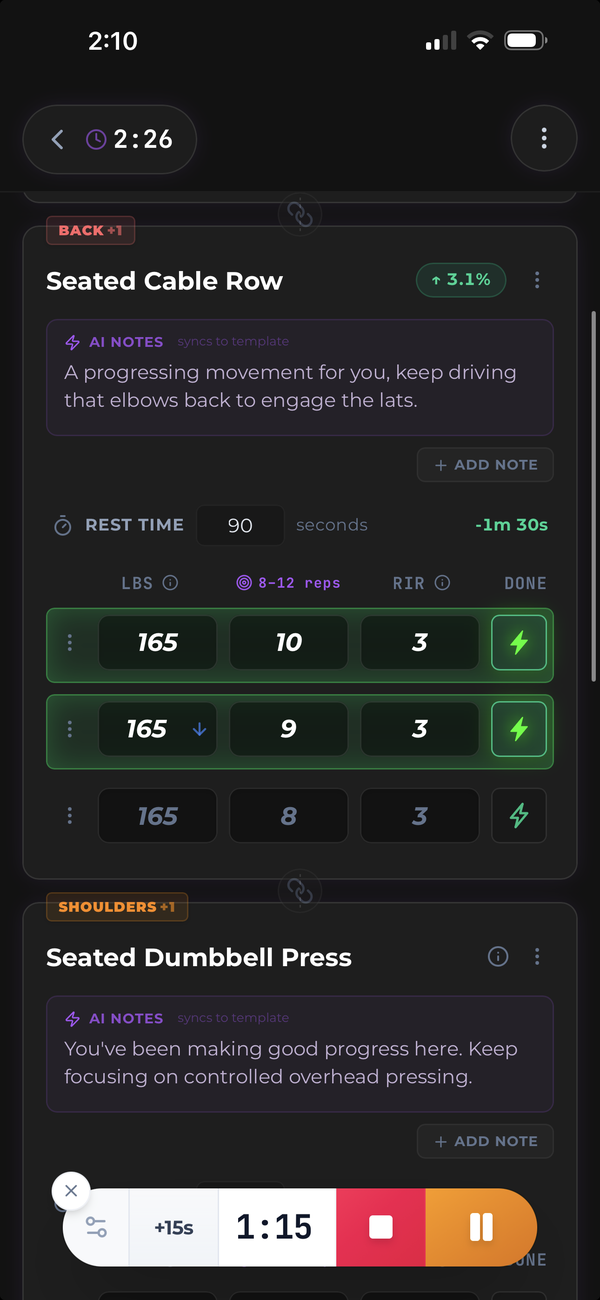
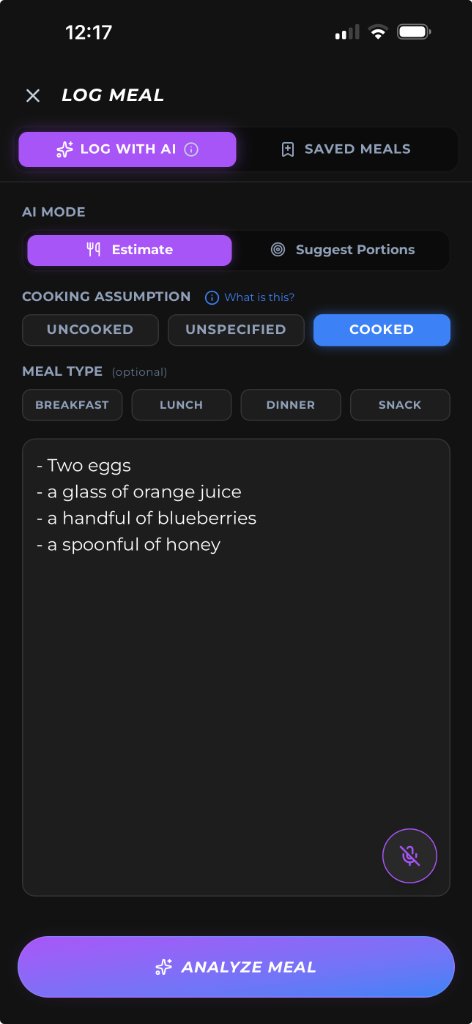
The two-app problem
Running a workout tracker and a nutrition app side by side means paying two subscriptions. But the money is the smaller half of it.
The bigger half is that two apps cannot answer a question that spans both. Whether your calories are moving in the same direction as your lifts. Whether the week you under-ate was the week your top sets fell off. Whether a cut is quietly costing you strength, or a bulk is turning into size rather than just weight. Those are the questions that decide what you do next, and they need one set of data, not two exports and a spreadsheet.
That is what the app is for. Here is the same question answered on one screen, from a real account — a cut running since early July:
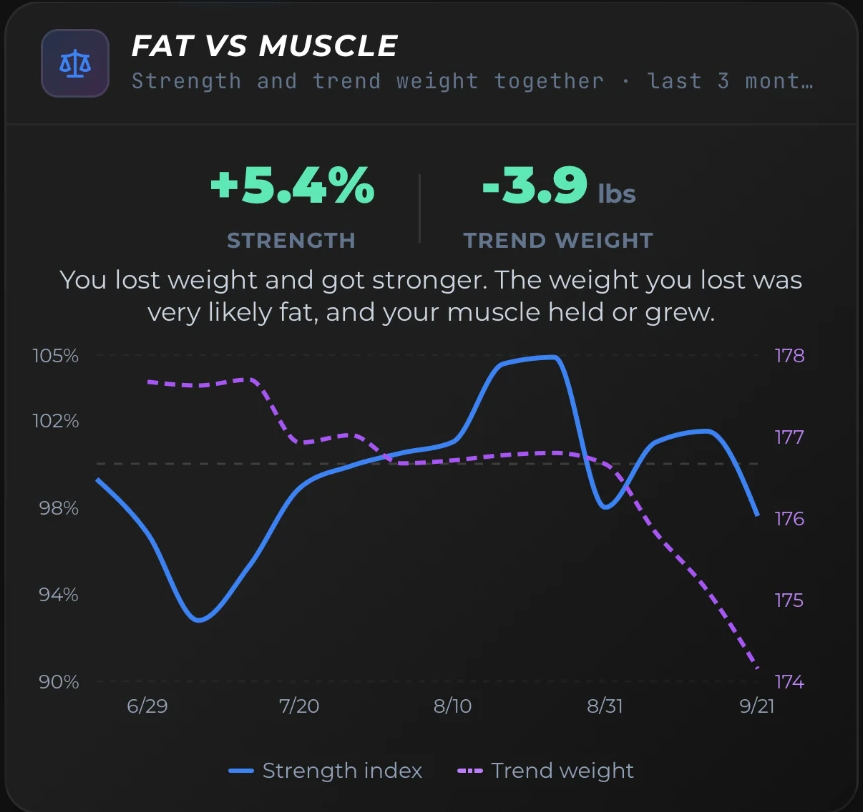
1 The verdict, in a sentence. Not two numbers for you to interpret — the app reads them together and tells you what happened: the weight came off and the strength stayed, so what you lost was very likely fat.
2 Where the two lines disagree. Trend weight falling while the strength index holds near its high is the whole point of keeping both in one place. A food app can draw the dashed line. A workout app can draw the solid one. Neither can put them on the same chart, which is the only place the answer lives.
Underneath it sits a report card for every cut, bulk and maintain phase you run — weight, strength, intake against burn, protein and sessions, each graded against what that goal actually expects rather than against a generic target.
It is also why the two-app setup tends to come apart. Logging is a habit, and a habit that needs two apps opened at two different moments has two chances to lapse — and it is usually the food half that goes first.
What’s in each half
Training
- Log every set, with full history on every lift
- Build your own programs, or have one built for you
- Optional RIR or RPE on any set — it sets your next target
- Strength trends and estimated one-rep maxes
- Your health data joins it — steps, sleep and body weight
Nutrition
- Describe a meal in plain English, or say it out loud
- Photograph the plate and let it read what is on there
- Scan a barcode straight off the packet
- Calories, protein, carbs and fat, against your targets
- A Real Food Score — how processed you ate, not just how much
How the food side actually works
The thing that makes logging food survivable is not the size of the database, it is how little you have to do to get an entry in. There are four ways in:
- Type it in plain English. “Chicken burrito bowl, extra rice, no cheese” is a valid entry. You are not searching a database and picking rows.
- Say it. There is a microphone in the meal logger — it keeps listening until you tap it off and shows the words as you speak, so you can log a meal while your hands are busy. On a browser that does not support speech, the button simply is not there.
- Photograph the plate. The AI reads the picture for two things: what the food is, and roughly how much of it is there. The per-unit nutrition then comes from the food data rather than from the AI — but it is multiplied by that estimated amount, so the totals are only as good as the portion guess. It is told to guess low when the size is ambiguous, and it flags the items it is unsure about so you know which ones to check.
- Scan a barcode, in the iOS and Android apps. The web app has manual barcode entry instead, because a browser cannot open the camera scanner.
It learns your foods, so it stops guessing
Behind all four routes is one pipeline, and its order matters: it checks foods it already knows and corrections you have personally made before it asks an AI anything. Change “a bagel” from 100g to your actual 85g once, and your correction outranks every other source the next time you log it. Resolved foods are remembered, so the meals you eat every week stop going through an AI at all.
It tracks calories, protein, carbs and fat as first-class numbers. Anything else — fibre, sugar, sodium, a micronutrient you care about — you can add as a custom target, but it is not tracked by default, and we would rather say that than let you find out in week three.
It also scores what you ate, not just how much
Two days can hit identical macros and be nothing alike. Every food you log gets a Real Food Score out of 100, based on how far it sits from the form it grew in — whole and unprocessed at the top, hyper-processed at the bottom — with added sugar, refined carbs, seed oils and artificial ingredients each pulling it down. Your stats carry the weekly average, so you can see the quality of your eating drift without having to audit a single label.
What it costs
Monthly
$11.99
per month
Cancel whenever you like.
Annual
$8.00
per month, billed as $95.99 a year
Four months cheaper than paying monthly.
Either way it is the whole app — both halves, one subscription. No separate nutrition add-on, no per-feature upsell, and nothing that costs extra because you happen to use both sides of it.
Common questions
Is there one app that tracks both workouts and food?
That is what this one is. Two tabs, one account, one subscription. The usual alternative is a lifting app plus a separate food app, which means two subscriptions and two sets of data that never meet.
Can I log food by talking instead of typing?
Yes — there is a microphone in the meal logger and you can just say what you ate. It shows the words as you go and keeps listening until you stop it, which matters when you are logging lunch one-handed.
How accurate is logging a meal from a photo?
Treat it as a good first draft, not a measurement. The AI makes two judgements from a picture: what the food is, and how much of it there is. The nutrition per unit is looked up rather than invented — but it gets multiplied by that estimated amount, so your calorie total is only ever as good as the portion guess, and a photo is much better at identifying a food than at sizing it.
Two things take the edge off that. It is instructed to be conservative when the size is ambiguous — a normal serving rather than a large one — and it marks the items it is least sure of, so you can see which ones are worth a second look. Correct a portion with a tap and everything recalculates, and it remembers the correction for next time.
What is the Real Food Score?
A score out of 100 on how processed a food is, so two days that hit the same macros do not look identical when one of them came out of a packet. Whole foods sit at the top and hyper-processed ones at the bottom, with added sugar, refined carbs, seed oils and artificial ingredients each pulling a food down. Your stats carry the weekly average. It is there to be glanced at, not obeyed — nothing in the app stops you logging whatever you want.
Does it work on Android as well as iPhone?
Yes — the same app, with both halves, on iPhone and Android. There is a web version too, for when you would rather log at a desk.
What does TRY Fitness cost?
$11.99 a month, or $95.99 a year — which is $8.00 a month, a third less than paying monthly. The only difference between them is how often you are billed; both are the whole app.
Do I need to use both halves?
No. You can log nothing but your training for months and only start on food when a cut begins. The point is that when you do start, everything is already in the same place.
Lifting & Nutrition, in one app
Get TRY Fitness$11.99/month, or $8.00/month billed annually · iPhone, Android and the web
This page describes how TRY Fitness behaves as of 21 September 2026, checked against the app’s own code on that date; features and integrations may change in later versions. Prices shown are in US dollars and may differ in your local store. Spotted something that no longer matches the app? Tell us and we’ll fix it.