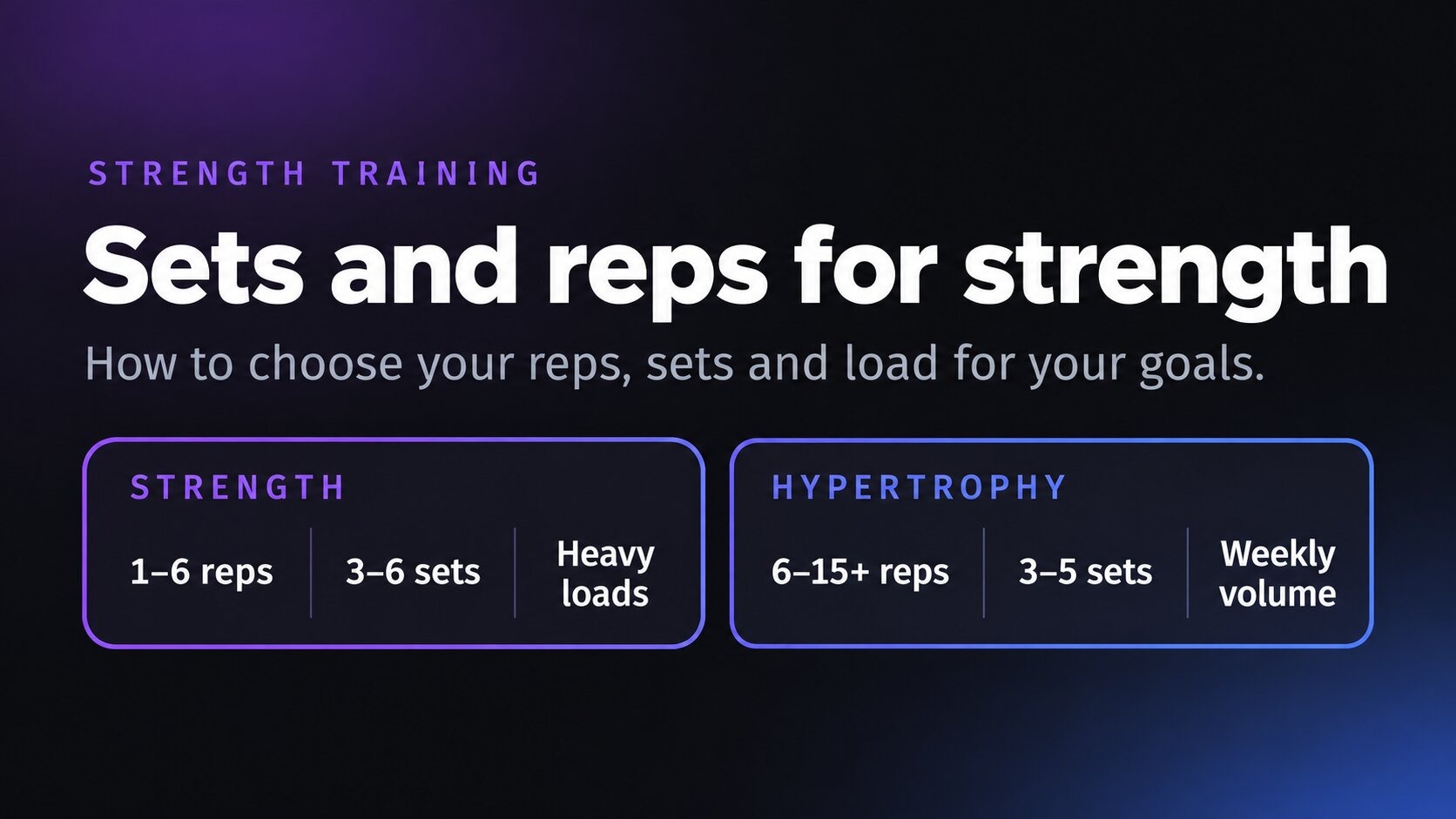
Quick Answer: Want to get stronger? You'll generally want to lift heavier, do fewer reps, and give yourself enough rest and proper nutrition to repeat those efforts. A common starting point is 3 to 6 sets of 1 to 6 reps at roughly 75 to 90% of your one-rep max. Hypertrophy training overlaps with these ranges, but puts more emphasis on accumulating enough weekly volume to stimulate muscle growth.
Walk into almost any gym and you'll see someone doing 3 reps with a weight that looks terrifying, while someone else is happily working through a set of 12. Both could be training effectively. The difference is what they're trying to achieve and how their workouts are structured.
If you're trying to get stronger, figuring out the right sets and reps is a good place to start. But there's more to it than simply loading up the bar and doing fewer reps. Let's look at how to structure your training, when to add sets instead of reps, and how to tell whether your numbers are actually moving in the right direction.
Sets and Reps for Strength: the Short Answer
Strength-focused training generally means lifting heavier weights for fewer reps, repeating those efforts across several sets, and resting long enough to do it again without your performance falling off a cliff. Most strength-focused lifters work in the 1 to 6 rep range, often using loads around 75 to 90 percent of their one-rep max, for 3 to 6 working sets per main lift.
Hypertrophy training often uses more reps and accumulates more total weekly volume, although there's plenty of overlap between the two. Strength work tends to put more emphasis on heavier loads, practicing the lift, and taking longer rests between sets. Think 2 to 5 minutes, depending on how demanding the set was.
A squat day built for strength might look like 5 sets of 3 reps at 85 percent of your max, with 3 minutes rest between sets. A bench day built for hypertrophy might look like 4 sets of 10 at a lighter weight, with 90 seconds rest.
TRY Fitness brings workout tracking and nutrition tracking together in one workout and nutrition app.
More Reps or More Sets?
More reps or more sets? It depends on what you're trying to get out of the workout. If your goal is a bigger squat or bench press, several challenging sets give you repeated practice with the movement. If you're chasing muscle growth, the focus shifts toward accumulating enough hard sets and reps across the week.
More sets give you more opportunities to practice a lift under a challenging load, which is useful when strength is the goal. More reps at a manageable weight can help accumulate the volume needed for muscle growth. Neither is automatically better. The load, effort, total volume, and how you progress all matter.
| Goal | Reps per set | Sets | Load | Rest |
|---|---|---|---|---|
| Strength | 1 to 6 | 3 to 6 | Roughly 75 to 90% of max | 2 to 5 min |
| Hypertrophy | 6 to 15 | 3 to 5 | Moderate to heavy | 1 to 3 min |
These are useful starting ranges, not gym commandments. You can build muscle with lower reps and strength with higher reps. What matters is how the training is programmed and progressed. The numbers in this post are common rules of thumb, not fixed rules.
A lifter chasing a bigger squat might benefit from adding another quality set of 3 reps rather than simply switching to higher reps. Someone chasing bigger quads might first try adding reps to existing sets before increasing the total number of sets.
How Many Total Sets per Workout for Hypertrophy Vs. Strength
A commonly used starting range for hypertrophy is 10 to 20 hard sets per muscle group per week, spread across sessions instead of one workout. Strength work usually runs fewer total sets per muscle group, since each set takes longer to recover from at near-max loads.
The right number for you depends on recovery and experience. A newer lifter may make progress with fewer weekly sets, while someone with more training experience may benefit from gradually increasing volume. But adding sets only helps when you can recover from them. Tracking what you actually complete each week matters more than chasing one universal number, because recovery capacity is personal.
Take someone training legs twice a week. They might do 4 heavy squat sets and distribute lighter accessory work, such as leg presses and leg curls, across both sessions. The idea is to spread the workload rather than cram everything into one workout.
How to Track Your Strength Trends Accurately Across Lifts
Your workout log might be full of numbers, but are those numbers actually telling you whether you're getting stronger? Tracking progress means comparing working sets over time, including how difficult those sets felt.
A log that only records weight and reps misses an important detail: how close you were to failure. A set of 8 at RIR 3 isn't quite the same effort as a set of 8 at RIR 1, even if the weight is identical.
TRY Fitness Pro builds your targets from your last workouts and updates them after every workout, so you walk in knowing what to lift next.
Tip: Logging RIR or RPE is free. The targets built from that data are part of TRY Fitness Pro.
Why RIR/RPE Targets Matter
RIR and RPE tracking add useful context to each set. Say you complete 8 reps and stop with 2 reps in reserve. That means you estimate you could have managed another two reps with good form. Without that context, your training log only sees 8 reps. With RIR tracking, it gets a better picture of how demanding the set actually was.
See how this works on the RIR & RPE Tracking That Sets Your Next Lift page.
How to Know If Your Program Is Actually Working
Feeling exhausted after a workout doesn't automatically mean your program is working. Neither does spending 90 minutes in the gym. If your goal is strength, you need to look at whether the program gives you enough challenging work, sensible progression, and room to recover.
Instead of trying to figure it all out yourself, paste your program into the free TRY Fitness analyzer and get a structural analysis. It works without an account. You can paste a training program or describe your weekly routine in your own words and get feedback in about 30 seconds.
Did you know? The TRY Fitness app can also compare the program you planned with what you actually logged, because a workout that looks great on paper and one you consistently complete aren't always the same thing.
This flags whether your sets, reps, and progression scheme actually match a strength goal before you spend weeks finding out the hard way.
Percentage-Based Programs (5/3/1, nSuns) and Rep Ranges
Percentage-based programs take some of the guesswork out of loading. Instead of choosing a weight based on how strong you feel that day, you calculate it using a percentage of your training max.
5/3/1 runs three-week cycles with main lift reps dropping from 5s to 3s to a final 5/3/1 week, each week loaded off that training max. The Boring But Big template adds additional 5-sets-of-10 volume work after the main lift.
nSuns is a higher-frequency program that runs the main lifts more often each week, with percentage-based sets and a "+" set where you do as many reps as you can.
Both programs depend on an accurate training max and correct plate rounding to work as written.
TRY Fitness Pro tracks percentage-based programs like 5/3/1 and nSuns. You set a training max for each lift, and the app works out the weight for each set, rounded to the plates you have. At the end of each cycle it raises your max by the program’s rule. Two are ready to open: 5/3/1 Boring But Big and nSuns 5-Day, with every week’s percentages and "+" sets ready to track in the TRY Fitness app.
Why TRY Fitness Fits This Kind of Training
You've got a program. You're logging your sets. But when you look back at the last few weeks, can you actually tell whether you're progressing?
TRY Fitness brings training and nutrition tracking together, so changes during a cut or bulk can be viewed alongside your strength trends. Instead of wondering why your lifts have stalled, you have more information to work with.
The free version covers all of your training log with no time limit. TRY Fitness Pro, which adds targets built from your last workouts, nutrition tracking and percentage programs, is $11.99 a month or $119.99 a year, on iPhone, Android and the web.
Start free, with no card, and run your next program through the free analyzer before you commit to another cycle. Get TRY Fitness.
TRY Fitness is not affiliated with or endorsed by Jim Wendler.