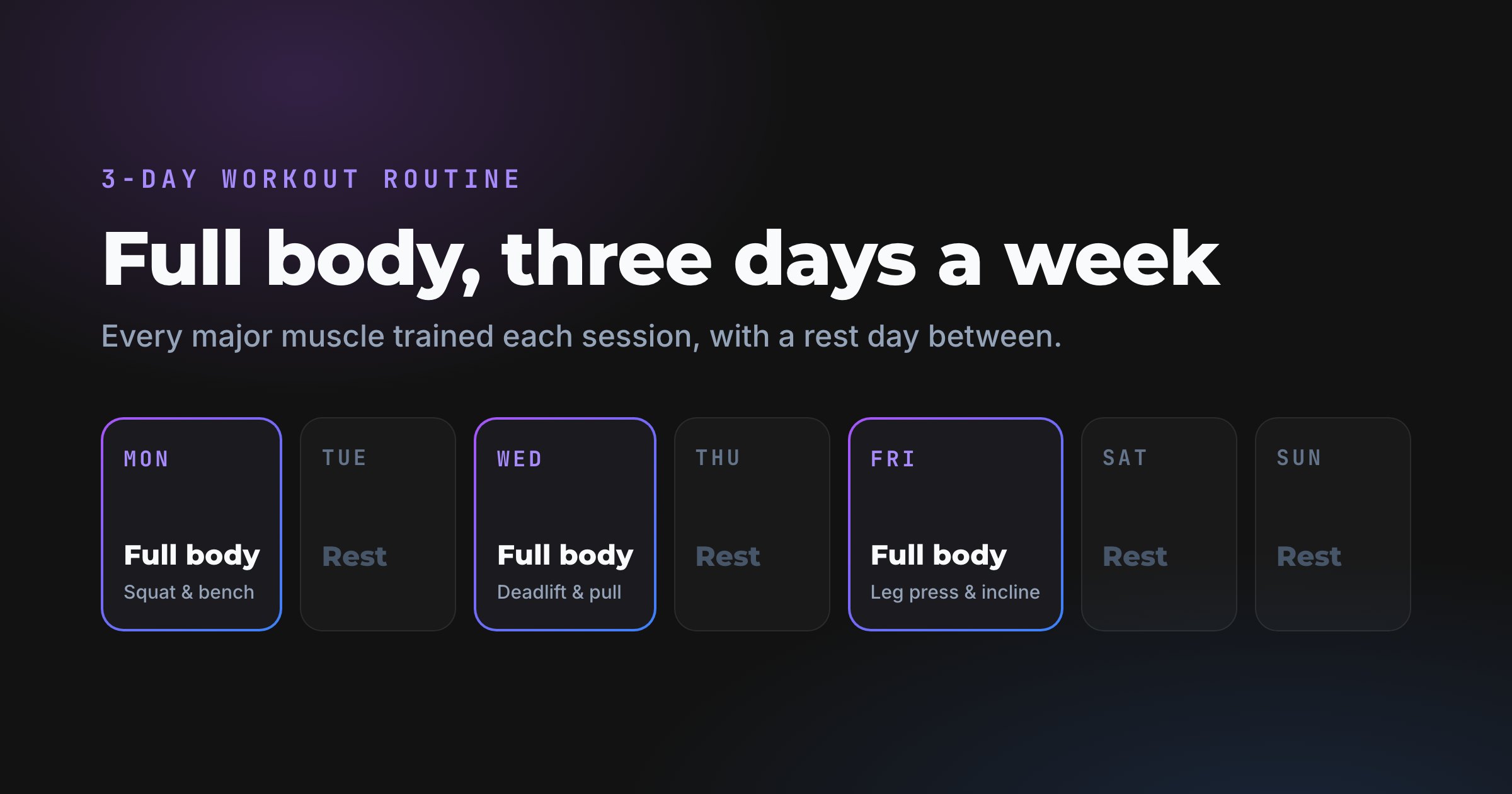
Quick Answer: A 3-day workout routine is a weekly strength-training schedule built around three sessions, spaced with rest days, that together train every major muscle group. It commonly runs on a Monday-Wednesday-Friday pattern. The format can be full-body, where the same muscles train each day, or split by movement, such as push/pull/legs.
Ready-made 3-day programs
- Full body, full gymThree full-body days with squat, hinge, push and pull each session.
- Full body, dumbbells and a benchThe same three-day layout for training at home.
Every exercise, set and rep, ready to track in the TRY Fitness app. See all workout programs or build your own.
A 3-day workout routine builds muscle and strength by training every major muscle group two to three times a week, with a rest day placed between sessions. Most programs use one of two layouts: full-body, where each session covers the whole body, or push/pull/legs, where each session targets one movement pattern.
Three weekly sessions also exceed the two days of muscle-strengthening activity per week that the CDC's Physical Activity Guidelines for Americans recommend for adults, so the schedule supports general health goals as well as muscle growth.
Can You Build Muscle Working Out Just 3 Days a Week?
Yes. Three sessions a week give you enough training frequency to build muscle, provided each major muscle group gets worked at least twice and is paired with proper nutrition and rest for recovery.
A 2016 systematic review by Schoenfeld, Ogborn and Krieger, published in Sports Medicine, found larger muscle gains when a muscle group was trained twice a week rather than once. A 2019 review that compared groups doing the same number of weekly sets found little difference, so the total number of hard sets you do each week matters most, and training each muscle twice a week is a convenient way to spread them out.
A full-body or push/pull/legs 3-day split naturally reaches that twice-weekly target for most muscles. Growth still depends on adding weight, reps, or sets over time rather than repeating the same workout indefinitely.
Pro Tip: Add small, steady increases: one more rep, a few more pounds, or an extra set every week or two, instead of jumping the weight all at once. This progressive overload is what keeps a 3-day routine producing results past the first few months.
What Does a Full 3-Day Workout Split Look Like?
A full-body 3-day split trains your entire body in each of the three sessions, usually with four or five main lifts plus a core exercise.
| Day | Focus | Example Exercises |
|---|---|---|
| Day 1 (Mon) | Full body | Squat, bench press, seated row, overhead press, plank |
| Day 2 (Wed) | Full body | Deadlift, pull-up or lat pulldown, dumbbell press, lunge, side plank |
| Day 3 (Fri) | Full body | Leg press, incline press, cable row, hip thrust, farmer's carry |
Each session rotates the main lift so your joints and muscles get variety while still training the same movement patterns across the week.
Many lifters build this kind of rotation by hand in a notebook, but with TRY Fitness you can build your own program with the three sessions, sets and reps laid out in one place.
Ready-Made Programs
If you'd rather not build the week yourself, these two programs follow the same Monday-Wednesday-Friday full-body layout, with every muscle group trained at least twice a week. Each lists every exercise, set and rep range.
- Full body, full gym: barbell squat, bench press, rows and Romanian deadlifts, with leg press, hip thrusts and pulldowns on the other days.
- Full body, dumbbells and a bench: goblet squats, dumbbell presses, one-arm rows and dumbbell Romanian deadlifts, for training at home.
Should You Train Your Whole Body or Split Muscle Groups Across Three Days?
Both approaches can work with three training days a week, but they distribute your training volume differently.
Full-body training is generally better suited to beginners because you work every major muscle group in each session, giving you more opportunities to practise the lifts and build technique. Push/pull/legs, on the other hand, dedicates each session to a smaller group of muscles, allowing for more focused workouts.
The catch is that a traditional three-day push/pull/legs split trains each muscle group only once a week. If muscle growth is your priority, full-body training may be the better option, since research suggests that training each muscle group twice a week can produce greater hypertrophy than training it once.
| Factor | Full-Body 3-Day | Push/Pull/Legs 3-Day |
|---|---|---|
| Best for | Beginners, general strength | Lifters wanting more volume per muscle |
| Session length | About 45-60 minutes | About 50-70 minutes |
| Frequency per muscle | 3x per week | 1x per week |
| Recovery demand | Moderate, spread evenly | Higher per session |
Session lengths here are common rules of thumb, not measured figures.
Is a 3-Day Workout Routine Enough for Strength Gains Long-Term?
Yes for beginners, with limits later on.
Three sessions a week are enough to build meaningful strength for the first several months, especially for people new to lifting. Progress usually slows once you've built a base, because, as a common rule of thumb, strength gains past the beginner stage tend to need more total weekly volume than three sessions easily fit.
Checking whether your current split still delivers enough volume per muscle is easier with a tool that can analyze your workout program for you, rather than estimating it by hand.
How Long Should Each Workout Session Last?
As a common rule of thumb, most 3-day sessions run 45 to 60 minutes, including warm-up.
A typical session might include 5 to 10 minutes of warm-up, 35 to 45 minutes for the main lifts, and a short cool-down. Depending on the number of exercises, rest periods, and training pace, some sessions may run beyond 75 minutes, particularly when you add isolation work or longer recovery periods between sets.
Avoid This Mistake: Be mindful of how much isolation work you add to a 3-day routine. Including too many extra exercises can make sessions longer and increase fatigue without necessarily producing proportional gains. Compound lifts already work multiple muscle groups, so use isolation exercises to address muscles that need additional attention rather than adding them just to make the workout longer.
How Many Rest Days Should You Take Between Workouts?
Leave at least one rest day between each of the three sessions.
A Monday-Wednesday-Friday pattern gives about 48 hours of recovery before training the same muscles again, which is a common rule of thumb for recovery between full-body sessions; some lifters need more or less. Light activity on off days, such as walking or stretching, doesn't interfere with recovery and is fine on rest days.
If Monday-Wednesday-Friday doesn't fit your week, a workout program builder can rearrange the three sessions around the days you actually have free.
What Exercises Should a 3-Day Workout Plan Include?
A well-built plan covers six movement patterns across the week, plus core work:
- Squat pattern - back squat, goblet squat, or leg press
- Hip-hinge pattern - deadlift, Romanian deadlift, or hip thrust
- Horizontal push - bench press or push-up
- Horizontal pull - seated row or dumbbell row
- Vertical push - overhead press
- Vertical pull - pull-up or lat pulldown
- Core - plank, side plank, or farmer's carry
Success Tip: Write down the weight and reps for every set. A simple log shows you exactly when to add weight next session, which matters more for progress than which specific exercise variation you pick.
Manually logging each session can get tedious, especially when you're tracking multiple exercises, sets, reps, and weights. TRY Fitness keeps your workout history in one place and shows your progress over time. Its targets are built from your last workouts and updated after every workout, which automates your progressive overload from one workout to the next.
Can Beginners Follow a 3-Day Gym Routine?
Yes, a 3-day full-body routine is a common starting point for beginners.
It trains each muscle group three times a week, which gives you plenty of practice on the main lifts, and it only requires three gym visits, which is easier to maintain than four or five.
New lifters who don't want to plan sets and exercises from scratch can start from one of TRY Fitness's ready-made workout programs instead.
Putting It Together
A 3-day workout routine can build muscle and strength without requiring you to spend half the week in the gym. Focus on training all major muscle groups, giving your body enough time to recover, eating well, and gradually increasing the challenge as you get stronger. If you're new to strength training, start with a full-body routine. As you gain experience, you can explore splits like push/pull/legs if they suit your goals and schedule. Keep track of your workouts, too, so you can see what's improving and where you might need to make adjustments.