Quick Answer: A full body workout trains every major muscle group in one session using compound lifts: a squat or hinge, a push, a pull, and a carry or core move. Run it two to four days a week with at least one rest day between sessions, and track load and reps to confirm it's actually working.
Ready-made full body programs
- Full body, full gymThe routine in this guide, three days a week.
- Full body, dumbbells and a benchFor training at home.
Free to open. Every exercise, set and rep, ready to track in the TRY Fitness app.
A good full body workout is not a random list of exercises. It is one squat or hinge, one push, one pull, and a finisher, repeated with a plan to add weight or reps over time.
What Counts as a Full Body Exercise Workout
A full body workout hits every major muscle group (quads, hamstrings, glutes, back, chest, shoulders and arms) in one session instead of spreading them across a split.
The bar is movement patterns, not a checklist of muscles. One squat or hinge, one push, one pull, plus a carry or core movement covers the whole body in four or five exercises.
Most full body exercises are compound lifts, which work several muscles at once. Exercises for a single muscle are an optional finisher.
This also makes scheduling simpler: fewer sessions to plan, more frequency per muscle group, and less guesswork about what you missed last week. If you log your sessions in an app such as TRY Fitness, you can look back and see which lifts you trained.
Full Body Workout for Beginners
Start with three sessions a week and one exercise per pattern. That is the whole beginner routine.
Pick loads you could lift two or three more times at the end of each set. Leave the ego at the door for the first month.
The first weeks may feel easy. That is normal, not a sign to add exercises.
Log every set from day one. The first four weeks of numbers become your baseline for everything after. The free training log in TRY Fitness has no time limit, so you keep that history.
Reality Check: Most beginners add exercises instead of adding weight to the ones they have. The first month should be boring on purpose.
The Full Body Workout Routine (Exercise List)
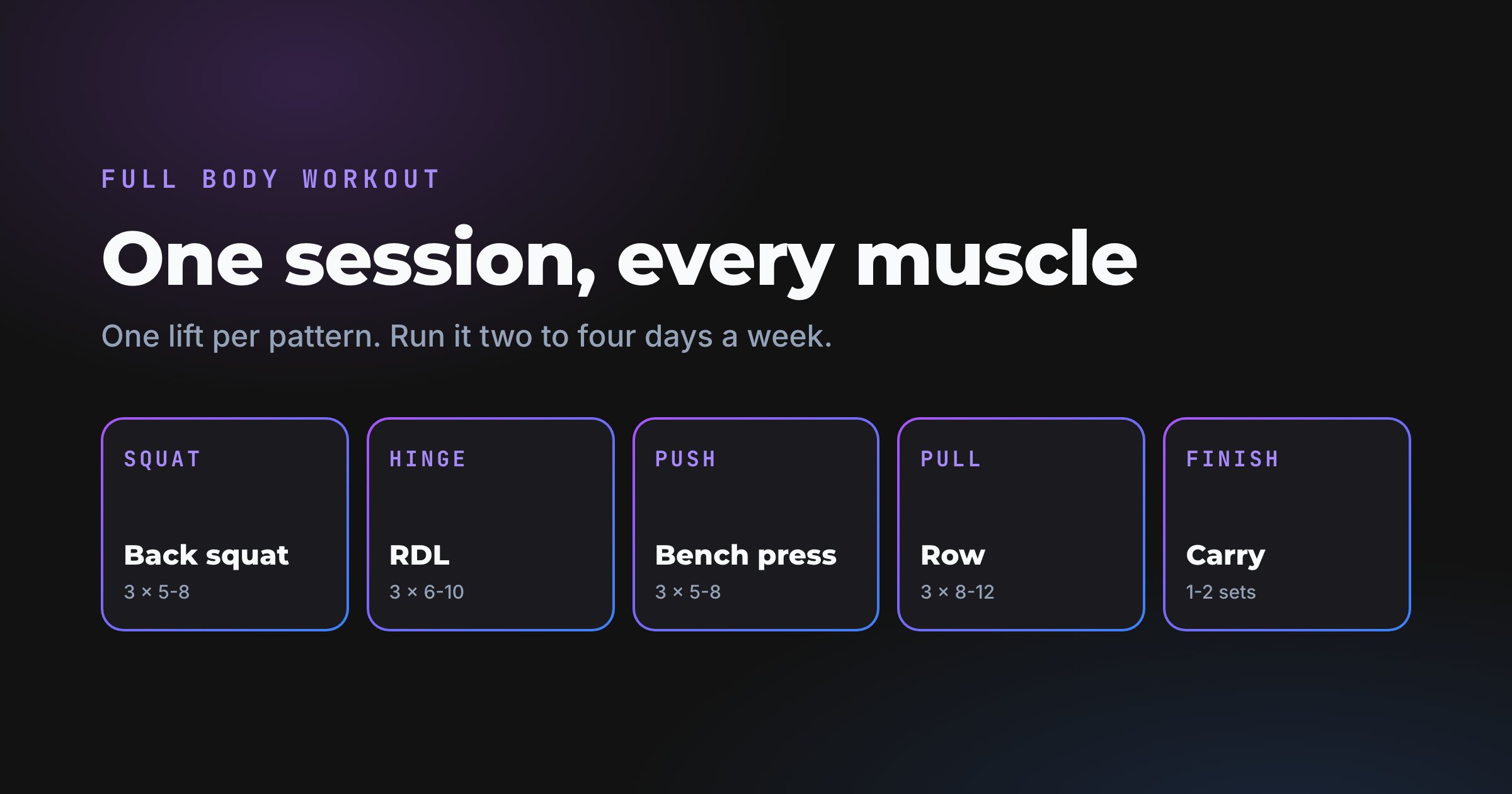
A full body session needs one lift per pattern and nothing more:
| Pattern | Example lift | Sets x Reps |
|---|---|---|
| Squat | Back squat or leg press | 3 x 5-8 |
| Hinge | Romanian deadlift or hip thrust | 3 x 6-10 |
| Push | Bench press or overhead press | 3 x 5-8 |
| Pull | Row or lat pulldown | 3 x 8-12 |
| Finisher | Carry or plank | 1-2 sets |
These sets and reps are a common starting point, not a rule. Arms get work from the pressing and pulling lifts; add a set of curls or triceps pushdowns at the end if you want more.
As a common rule of thumb, keep the same lifts for six to eight weeks before swapping them. Progress is easier to see on a lift you repeat.
Full Body Dumbbell Workout Variation
A full body dumbbell workout needs no rack: goblet squat, dumbbell Romanian deadlift (RDL), dumbbell bench press and one-arm row. The same sets and reps apply. It suits home lifters who track the same numbers week to week in a workout and nutrition app.
Full Body Calisthenics Variation
A full body calisthenics workout uses leverage instead of plates: split squat, slider leg curl, push-up progression and chin-up. Start with easier versions (incline push-ups, assisted chin-ups) if the full movement is too hard.
Ready-Made Full Body Programs
Each program below is free to open. It shows every exercise, set and rep, plus the program’s report card from TRY’s program analyzer. You can track either one in the TRY Fitness app. If you are brand new, start every exercise at two or three sets.
- Full body, full gym: the routine above as three sessions a week, with arm, calf and shoulder work added.
- Full body, dumbbells and a bench: the dumbbell version for training at home.
How Many Days a Week Should You Train Full Body
As a common rule of thumb, two days a week can maintain strength and three days is enough to build it for most beginners. Four works too if each session stays short.
Is four full body workouts a week enough? Yes, if each session is short and you're not stacking heavy squats and heavy deadlifts on back-to-back days.
A schedule most people can stick to is Monday, Wednesday and Friday, with a rest day between each. On a four-day setup, make two sessions heavier and two lighter, and keep every set a couple of reps short of failure.
Your training log should show the gap between sessions. If it keeps stretching past five days, the schedule is the problem, not the program. If missed sessions are the real issue, an accountability group lets you and your friends put a deposit behind a weekly workout goal.
How to Know If the Workout Is Working
Many beginners see the top set on a main lift go up within a few weeks if they log it, though progress varies with sleep, food and experience. If it has not moved after about six weeks, change something small first (more rest or a lighter restart), then change the program.
Bodyweight and measurements move slower than the bar. Judge the program on strength first, composition second.
Rule of thumb: Strength on the main lift is the earliest signal a full body program is working. Visible change lags it by weeks.
Progressive overload means adding weight or reps over time. TRY Pro automates your progressive overload: it builds a target for every exercise from your last workouts and updates it after every workout. Your history and PRs stay in the free training log.
Run any program through the free program analyzer before you commit eight weeks to it, no account needed.
How to Turn This Into a Program
A full body program is this same routine with dates, loads and a progression rule attached. The exercises stay the same.
Write the progression rule down before week one: add reps to the top of the range, then add weight and drop back to the bottom.
Build it as a template in your own training log, with the exercises, a rep range for each, and the progression rule.
Re-run the analyzer every six to eight weeks, because a program that fit in month one often needs changes by month four. You can start logging your workouts free, with no card required.