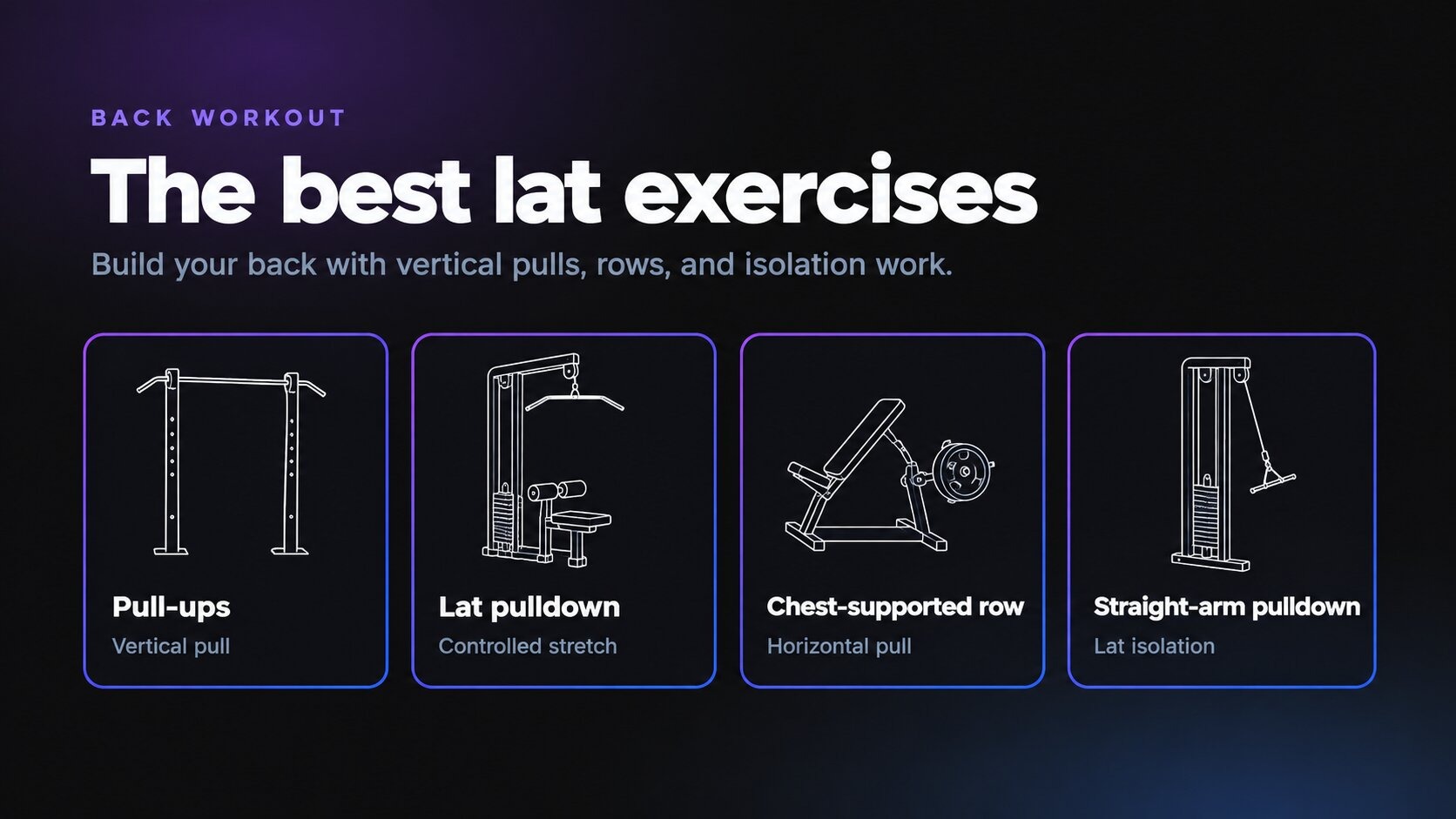
Quick Answer: The best lat exercises include pull-ups, lat pulldowns, rows, straight-arm pulldowns, and pullovers. Combine vertical pulls, rows, and isolation exercises to train your lats through different movement patterns. Track reps and proximity to failure using RIR or RPE to guide when to increase the weight.
Your latissimus dorsi muscles, or lats, run from your upper arms across your back toward your lower spine and pelvis. They help pull your arms down and back, making them essential for building a wider, stronger back. A balanced lat workout should include both vertical pulls and rows, with isolation exercises to add more targeted work.
What the Lats Do and Why They're Easy to Neglect
The lats pull your arm down and back, toward your body. That happens in pull-ups, rows, pulldowns, and even in swimming strokes. Exercises where your elbow travels from overhead or out in front, back toward your ribs, usually train the lats.
Lats often lag when lifters default to horizontal rows and skip vertical pulling. A row trains the lats through a shorter range than a pull-up or pulldown, where your arm starts fully overhead. Without that overhead stretch, the lats get less work at their longest length.
The Best Lat Workout Exercises (Ranked by Effectiveness)
As a common rule of thumb, the most effective lat exercises tend to be the ones that load the lats through the longest range of motion, so vertical pulls come first. This order is a common rule of thumb based on range of motion, not a ranking measured in a study.
Vertical Pulls (Pull-Ups, Lat Pulldown)
Pull-ups and lat pulldowns put your arm overhead at the start of the rep, stretching the lats before you pull. A weighted pull-up, or a pulldown at a weight you can control through the full range, works the muscle through most of its length. If a strict pull-up is too hard, the pulldown lets you load the same pattern at a lighter weight and build toward it.
Horizontal Pulls (Rows)
Rows pull your elbow back toward your ribs instead of down from overhead, and you can do them with a barbell, dumbbells, or a chest-supported machine. They work the lats through a shorter range, but you can often load heavier and add volume with less grip and shoulder fatigue. A chest-supported row also reduces lower back demand, so you can push closer to failure.
Isolation Moves (Straight-Arm Pulldown, Pullover)
Straight-arm pulldowns and pullovers isolate the lats with a straight arm, so the biceps do much less of the work. They're a good finisher after vertical and horizontal pulls, or a way to feel the lats working if you struggle to feel them during pull-ups.
| Exercise | Equipment | Main Emphasis |
|---|---|---|
| Pull-up | Bar or assisted machine | Full lat length, upper back |
| Lat pulldown | Cable machine | Full lat length, easier to scale |
| Barbell row | Barbell | Lat thickness, mid back |
| Chest-supported row | Bench, dumbbells or machine | Lat thickness, less lower back fatigue |
| Straight-arm pulldown | Cable machine | Lat isolation, mind-muscle connection |
| Pullover | Dumbbell or cable | Lat stretch, serratus |
How to Program Lat Exercises Into Your Week
A common approach is to train back twice a week and split their sets across vertical and horizontal pulls. One session can lead with a heavy vertical pull like weighted pull-ups, the other with a heavier row.
Pair a vertical pull with a horizontal pull in the same session rather than doing five variations of one pattern. For example: 4 sets of lat pulldown, then 3 sets of chest-supported row, then 2 sets of straight-arm pulldown as a finisher. That covers the full range of motion and both loading styles in one workout.
How to Know When to Add Weight or Reps (RIR/RPE)
RIR (reps in reserve) and RPE (rate of perceived exertion) measure how close a set came to failure, but they run in opposite directions. RIR counts the reps you had left, so a lower number means a harder set. RPE rates the effort, so a higher number means a harder set. RIR 2 means you could have done two more reps, which is roughly RPE 8. Tracking either one tells you whether last week's pulldown set was harder or easier than it looked on paper.
Watch Out: Adding weight to the bar without tracking effort can hide a stall. If your pulldown weight goes up but your RIR also rises, you are stopping further from failure, so the heavier weight may not make the set harder.
If you want RIR or RPE logged next to every set, TRY Fitness is a workout tracking app built for lifters. You log weight, reps, and RIR or RPE for each set, and the app keeps your history in one place. On the Pro tier, TRY Fitness automates your progressive overload: each exercise gets a target weight and reps built from your last workouts and updated after every workout. Those targets use your logged effort alongside the weight on the bar, which helps catch the stall described above. Logging RIR or RPE is free; the targets are part of Pro.
Common Mistakes That Stall Lat Growth
Not training close to failure is a common reason lat growth stalls. If every working set ends at RIR 4 or 5 (roughly RPE 5 or 6), the lats may not get enough challenge to grow, however many exercises you cycle through. That is a common rule of thumb rather than a fixed threshold. If you are new to lifting, build up to training close to failure gradually and keep your form strict.
Not tracking previous sessions is another common mistake. Without a record of last week's weight, reps, and effort, it's easy to repeat the same numbers for months and call it progress.
Tip: If rest breaks stretch longer than you planned, you will finish fewer sets in the same session. Set a rest timer for each exercise to keep back day on schedule.
The free version of TRY Fitness includes your full training log with no time limit, so you can track every rep and RIR score before deciding on a paid plan. It also has a rest timer that still alerts you when your phone is locked.
To keep your back day history in one place, start TRY Fitness free, no card needed, and look back at your weights, reps and RIR after a few sessions.