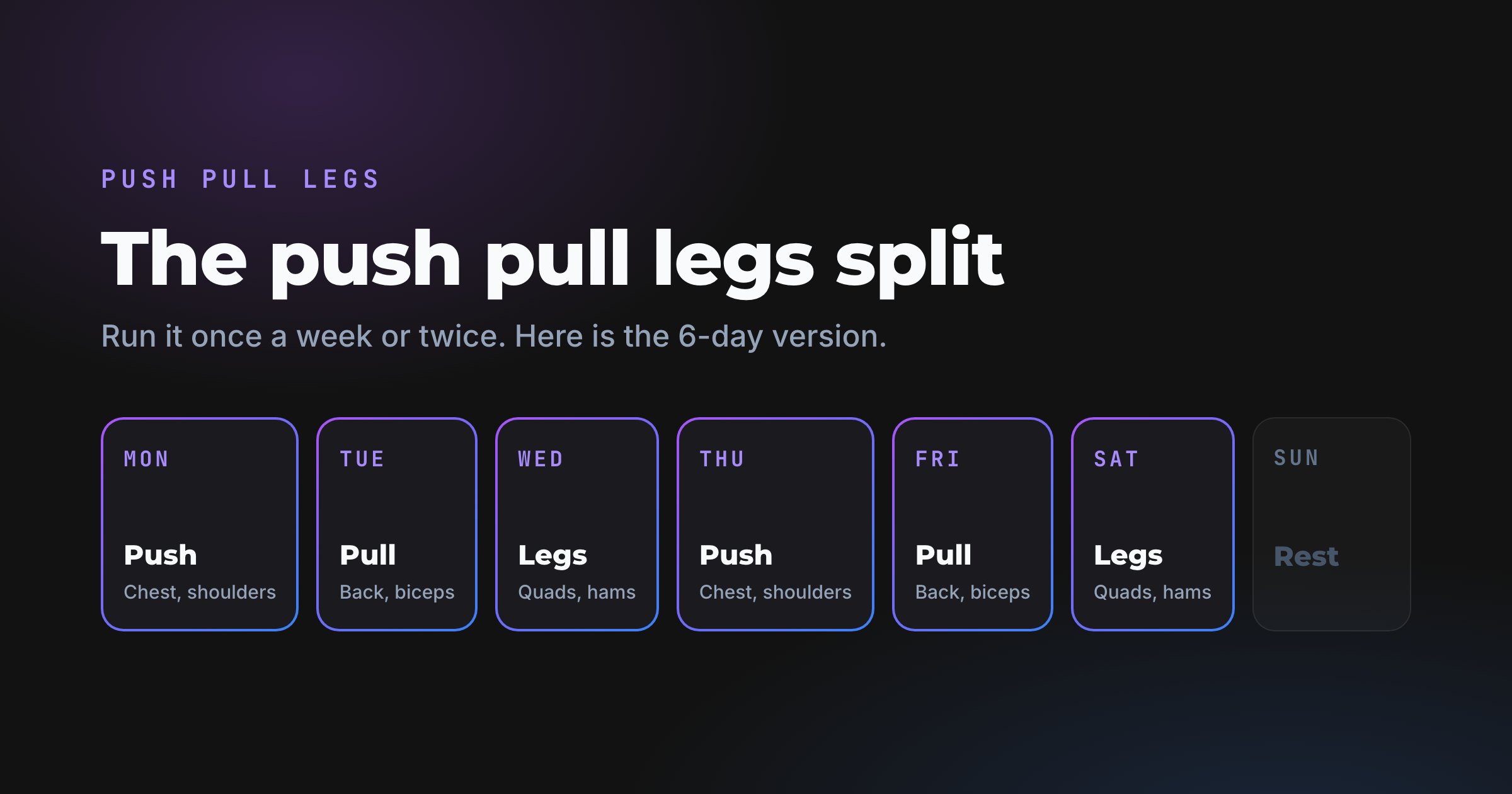
Quick Answer: A push pull legs training split groups workouts by movement pattern: chest, shoulders, and triceps on push day; back and biceps on pull day; and quads, hamstrings, glutes, and calves on leg day. You can run it as a 6-day, 3-day, or 4-day schedule depending on how much time you have and how well you recover.
Ready-made push pull legs programs
- Push pull legs, 6 days, full gymBuilt from the sample week in this guide, with a second version of each day.
- Push pull legs, 6 days, dumbbells and a benchFor training at home.
Free to open. Every exercise, set and rep, ready to track in the TRY Fitness app.
What Is a Push Pull Legs Split?
A PPL split groups exercises that use similar muscles into the same workout. Pressing movements such as bench presses and overhead presses go together, as do pulling movements such as rows and pulldowns. Squats, leg presses, and other lower-body exercises make up the leg session.
This works because muscles that work together on the same day also recover together. You're not hitting your triceps hard on Monday, then again on Wednesday when they're still sore from pressing. Many lifters like this spacing because each muscle group gets a few days off between sessions.
A PPL split also scales. You can run it twice through the week for six training days, or once through for three. If you're deciding between a static spreadsheet and an app that sets your next targets from what you logged, TRY Fitness logs your split and automates your progressive overload.
6-Day vs 3-Day PPL: Which Schedule Fits Your Life
A 6-day PPL repeats the push, pull, leg sequence twice in one week, usually with one rest day. A 3-day PPL runs the sequence once, with rest days spread around it. A 4-day hybrid adds a fourth day to the 3-day version, so some muscles get a second session each week.
The table below gives common rules of thumb, not fixed rules.
| Schedule | Days/week | Best for | Recovery demand |
|---|---|---|---|
| 6-day PPL | 6 | Experienced lifters, high recovery capacity | High |
| 3-day PPL (once weekly) | 3 | Beginners, busy schedules, limited recovery | Low |
| 4-day hybrid | 4 | Intermediate lifters wanting more frequency without 6 days | Moderate |
The 6-day version trains each muscle group twice a week, while the 3-day version trains each muscle group once. The six-day schedule lets you distribute your weekly training across more sessions, while the three-day version is easier to fit around a busy schedule.
What a 4-Day Hybrid Looks Like
There are two common ways to set up a 4-day push pull legs week.
Push, pull, legs, upper. Run the three PPL days, then add an upper-body day that has one or two exercises each for chest, back, shoulders and arms:
- Monday: Push
- Tuesday: Pull
- Thursday: Legs
- Friday: Upper
Your upper body gets two sessions a week and your legs get one. This fits lifters who want to put more of their training into their upper body.
Rolling PPL. Train four days a week and keep going through the push, pull, legs order without restarting it each Monday. If one week is push, pull, legs, push, the next week starts with pull. Over three weeks you do each workout four times, so every muscle group is trained a little more than once a week.
The first option keeps the same schedule every week, which is easier to plan around. The second treats every muscle group the same, but your workout on a given weekday changes from week to week.
The best option is the one you can recover from and follow consistently. More training days are not automatically better if they make the program harder to maintain.
Sample Push Pull Legs Program (Exercises, Sets, Reps)
Here's a straightforward PPL layout to start from:
- Push day: Barbell bench press 4x6-8, overhead press 3x8-10, incline dumbbell press 3x10-12, lateral raise 3x12-15, triceps pushdown 3x12-15
- Pull day: Deadlift 3x5, barbell row 4x6-8, lat pulldown 3x10-12, face pull 3x15, barbell curl 3x10-12
- Leg day: Back squat 4x6-8, Romanian deadlift 3x8-10, leg press 3x10-12, leg curl 3x12-15, calf raise 4x15
Keep a record of the weight, reps, and sets you complete so you can compare each workout with your previous sessions. That makes it easier to see whether your lifts are actually progressing instead of relying on memory.
These sets and reps are a common starting layout, not a prescription. If you're new to lifting, begin with lighter weights and learn the lifts first.
Good to know: A program that lists exercises and rep ranges but never says how to progress from week to week leaves you guessing at every session.
Ready-Made Push Pull Legs Programs
Each program below is free to open. It shows every exercise, set and rep, plus the program’s report card from TRY’s program analyzer. You can track any of them in the TRY Fitness app.
- Push pull legs, 6 days, full gym: the sample week above as the A days, plus a B version of each day with different exercises, so every muscle is trained twice a week.
- Push pull legs, 6 days, dumbbells and a bench: the same weekly layout for training at home.
Is It Better to Do PPL or PLP?
PPL (push, pull, legs) is the standard order, and it works well for most schedules. PLP (push, legs, pull) is a variation some lifters use to manage fatigue carryover.
The reasoning behind PLP is mainly about exercise selection and how much fatigue carries from one session to the next. Pull days can include deadlifts and rows that place demands on your lower back and grip, while leg days can include squats and Romanian deadlifts that create similar demands. Separating those sessions may feel better for some lifters.
In practice, stick with standard PPL unless you notice that your pull-day performance is consistently worse after leg day. If your schedule already gives you enough recovery between those sessions, the order may make little practical difference.
How to Progress Each Workout Without Guessing
Progressive overload is an important part of a hypertrophy program, but knowing that you need to progress is different from knowing what to do in your next workout. You might finish a bench press session with 135 lb for 8 reps and still be unsure whether next week's target should be 140 for 6, 135 for more reps, or the same weight again.
A useful progression system gives you a clear way to make that decision based on what you actually completed. If you repeatedly use the same weight and reps without improving, progress can stall. On the other hand, increasing weight too aggressively can make it harder to complete your planned work with good technique.
Using Reps in Reserve and Rate of Perceived Exertion to Guide Progression
RIR (reps in reserve) and RPE (rate of perceived exertion) measure how close a set brought you to failure. Tagging your sets with RIR records how much you actually had left, not just what the program assumed.
For example, if you finish a set and estimate that you had two reps left, that gives you more information than the weight and rep count alone. Over several sessions, those logs can help you judge whether a target was too easy, appropriately challenging, or too difficult.
The important part is consistency. Record the weight, reps, and effort for your working sets, then use those numbers to make your next adjustment instead of changing everything from workout to workout.
Common PPL Mistakes That Stall Muscle Gains
Running a PPL split doesn't guarantee progress. A few patterns cause lifters to stall out for months without realizing why.
- No deload: Running a demanding program continuously can allow fatigue to build up. A lighter training period can be useful when performance, recovery, or motivation starts to drop.
- Chasing volume blindly: Adding sets every week without checking whether your performance is improving can leave you doing more work without getting more from it.
- Ignoring RIR/RPE: Writing down "did my sets" without noting how hard they were means you can't tell a good week from a bad one.
- Copying someone else's program exactly: A split built for a 6-day schedule doesn't compress cleanly into 3 days without cutting volume somewhere.
Note: If your bench press hasn't moved in three straight sessions, treat that as a reason to look at your recovery, technique, exercise selection, and progression strategy rather than simply adding more sets.
There is no single adjustment that fixes every stalled lift. Look at the trend across several sessions before deciding whether you need more volume, less fatigue, a different progression target, or simply more time.
How Bodybuilders and Arnold-Era Lifters Actually Split Training
Classic 1970s and 80s bodybuilding splits, such as the one Arnold Schwarzenegger trained on, were often six-day routines. A common version paired chest and back, shoulders and arms, and legs, and ran that sequence twice a week, so each muscle was trained two or more times a week with high volume. Many other bodybuilders of the era trained each muscle once a week.
Modern PPL groups the week by movement instead of by body part. A 6-day PPL trains each muscle group twice per week, and a 3-day version trains each once.
One 12-week trial in untrained women compared a split routine with a full-body routine that did the same weekly work, and found no clear difference in strength or muscle gain. That suggests total weekly work matters more than how you divide it. The study was small, so treat it as one data point: randomized trial comparing split-body and full-body training.
The main difference from Arnold-era training isn't the exercises. It's how the sessions are grouped and how closely progression gets tracked.
TRY Fitness for PPL Tracking
If you're running a PPL program, logging the workout is only half the job. You also need to know whether you're progressing and what to aim for in the next session.
TRY Fitness tracks your exercises, sets, reps, and weights. It builds your targets from your last workouts and updates them after every workout, so it automates your progressive overload. You can use basic weight and rep logging or track intensity with reps in reserve and rate of perceived exertion.
It also combines workout and nutrition tracking in the same app, so you can keep your training and nutrition together instead of using separate apps.
The free plan includes unlimited workout logging, your full training history and personal records, and your own templates and programs. Pro adds adaptive targets, nutrition logging, and the AI workout and program features.