Building muscle takes more than picking a few exercises and showing up at the gym. You need a training routine that gives every muscle group enough attention without leaving you too tired to recover or train consistently.
That's where choosing the right workout split comes in. If you want to balance training frequency, recovery and time in the gym, the upper lower split is worth understanding.
Upper Lower Split, Defined: An upper lower split is a resistance-training schedule that alternates upper-body sessions with lower-body sessions, instead of training the whole body every session. Each muscle group gets trained about twice a week, which makes it easy to spread your weekly sets across shorter, focused sessions. It differs from a push/pull/legs split by grouping muscles by body region rather than by movement pattern.
Ready-made upper/lower programs
- Upper/lower, full gymThe four-day layout in this guide, with a squat-focused and a hinge-focused lower day.
- PHULTwo heavy days and two higher-rep days, for strength and size together.
- Upper/lower, dumbbells and a benchThe same four-day split for training at home.
Every exercise, set and rep, ready to track in the TRY Fitness app. See all workout programs or build your own.
Why Choose an Upper Lower Workout Split?
Full-body routines train all major muscle groups in a single session, while an upper lower split spreads that work across separate days. You get more focused sessions without having to dedicate an entire day to just one muscle group.
This also gives you more room to spread your weekly exercises and sets across the week instead of squeezing everything into one workout. You can give individual muscle groups more attention in each session while keeping the overall schedule manageable. For people who want to train consistently without spending five or six days at the gym, that balance is particularly useful.
How Many Days a Week Should You Do an Upper Lower Split?
Most lifters run an upper lower split four days a week, training each half of the body twice. It is a common way to balance weekly volume against recovery time between sessions for the same muscles.
You can run an upper/lower workout program on fewer or more days depending on your schedule:
- 2-day split: one upper day and one lower day per week, best for very busy schedules or true beginners.
- 3-day split: alternates upper and lower, so each half gets trained about 1.5 times per week on average.
- 4-day split: the standard version, training each half of the body twice.
- 5- or 6-day split: adds extra upper or lower days, usually for advanced lifters chasing more weekly volume.
A 2016 meta-analysis in Sports Medicine found larger muscle gains when a muscle was trained more often. A 2019 review that compared groups doing the same number of weekly sets found little difference between training a muscle once or twice a week. So the total number of hard sets you do each week matters most, and a twice-weekly split is a convenient way to spread those sets out.
4-Day Upper Lower Training Schedule for Muscle Growth
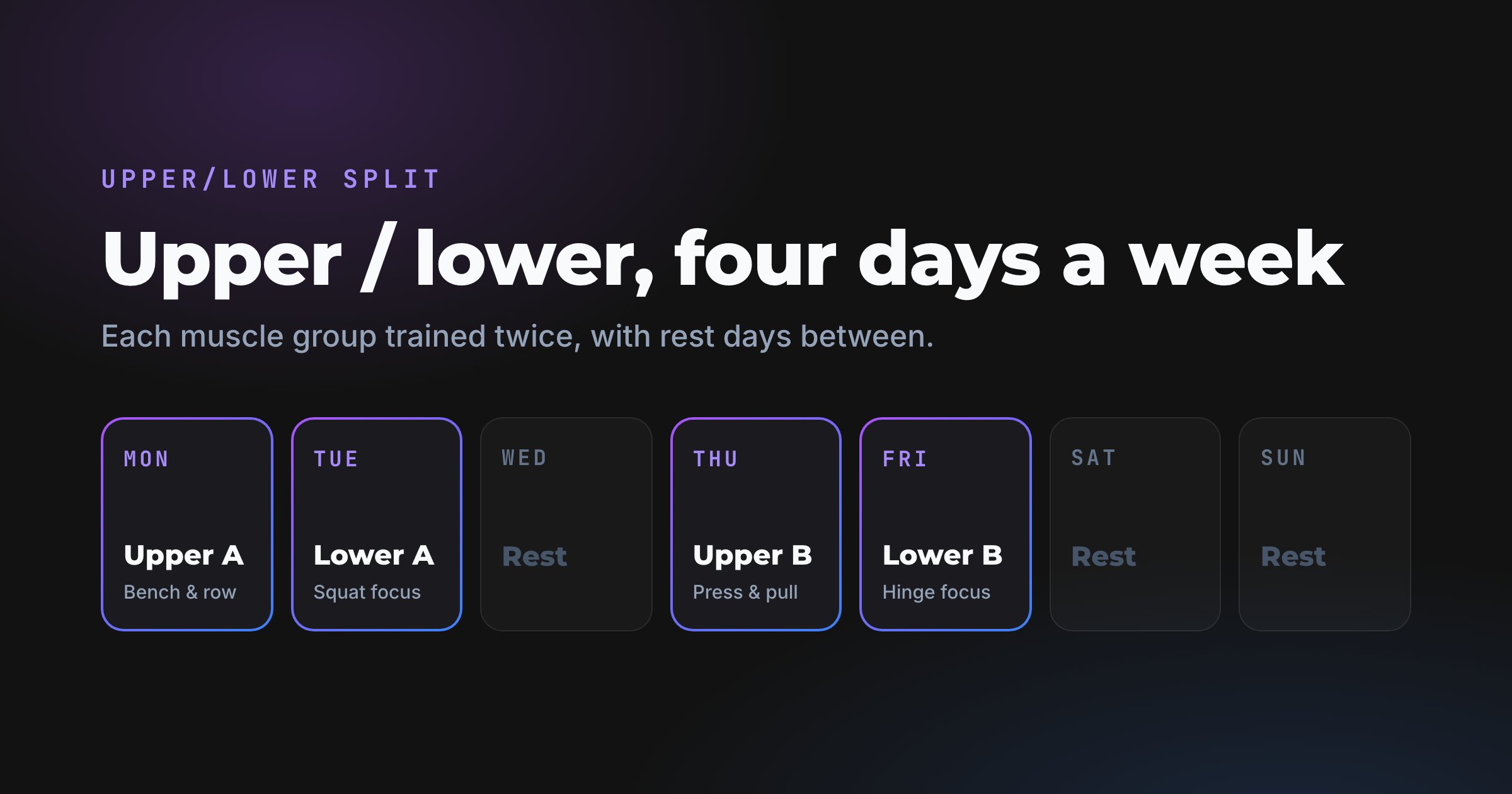
A 4-day upper lower training schedule splits the week into two upper and two lower sessions, with rest days spaced around them. The most common layout looks like this:
- Monday: Upper Body A (horizontal press and pull emphasis)
- Tuesday: Lower Body A (squat pattern emphasis)
- Wednesday: Rest or light cardio
- Thursday: Upper Body B (vertical press and pull emphasis)
- Friday: Lower Body B (hinge pattern emphasis)
- Saturday and Sunday: Rest
Having two different upper and two different lower sessions adds variety to your exercises and emphasis across the week. It also spreads the stress on your joints and lets you train each muscle from more than one angle.
Avoid This Mistake: Don't schedule your heaviest lower-body sessions too close together, especially if they involve demanding lifts like squats and deadlifts. Leaving a rest day or a lighter training day between lower-body sessions gives your legs more time to recover and helps you keep performance up across both workouts.
How Do You Select Upper Body Exercises for Hypertrophy?
Your upper-body workouts should cover both pushing and pulling movements, along with exercises that directly target smaller muscle groups like the biceps, triceps and shoulders. You can spread these across your two weekly upper-body sessions rather than repeating the exact same exercises each time.
Here are some exercises to include, with suggested sets and reps (common starting ranges, not fixed rules):
| Movement | Exercise Examples | Sets | Reps |
|---|---|---|---|
| Horizontal press | Barbell bench press, dumbbell bench press | 3 | 6-10 |
| Vertical press | Overhead press, dumbbell shoulder press | 3 | 8-12 |
| Horizontal pull | Seated cable rows, dumbbell rows | 3 | 8-12 |
| Vertical pull | Pull-ups, lat pulldowns | 3 | 8-12 |
| Biceps isolation | Dumbbell curls, hammer curls | 2-3 | 10-15 |
| Triceps isolation | Cable pushdowns, overhead extensions | 2-3 | 10-15 |
| Shoulder isolation | Lateral raises | 2-3 | 12-15 |
You don't need to squeeze every exercise into both upper-body sessions. For example, you could prioritize bench presses, rows and lateral raises on Monday, then overhead presses, lat pulldowns and arm exercises on Thursday. Adjust the selection based on your training experience, available equipment and recovery.
Which Lower Body Exercises Should You Include?
Your lower-body sessions should cover squat and hinge movements, single-leg exercises and isolation work. This spreads training across the quads, hamstrings, glutes and calves instead of relying on just squats and deadlifts.
Here are some exercises you can work into your two weekly lower-body sessions:
| Movement | Exercise Examples | Sets | Reps |
|---|---|---|---|
| Squat pattern | Back squats, front squats, leg press | 3 | 6-10 |
| Hinge pattern | Romanian deadlifts, conventional deadlifts, hip thrusts | 3 | 6-10 |
| Single-leg pattern | Walking lunges, Bulgarian split squats, step-ups | 2-3 | 8-12 per leg |
| Hamstring isolation | Lying leg curls, seated leg curls | 2-3 | 10-15 |
| Calf work | Standing calf raises, seated calf raises | 2-3 | 12-15 |
The sets and reps above are common starting points, not fixed rules. If you're new to squats and deadlifts, start light and learn the form first, or begin with the leg press and Romanian deadlifts.
You can vary the emphasis between your two lower-body sessions. For example, Tuesday could focus more on squats and quad-dominant exercises, while Friday could prioritize Romanian deadlifts, hip thrusts and hamstring work.
Ready-Made Programs
If you'd rather not put the week together yourself, these three programs follow the four-day upper/lower layout above, with every muscle group trained twice a week. Each lists every exercise, set and rep range.
- Upper/lower, full gym: bench press, barbell rows and pulldowns on Upper A; incline dumbbell press and cable rows on Upper B; back squats and leg press on Lower A; Romanian deadlifts, hip thrusts and Bulgarian split squats on Lower B.
- PHUL: one heavy and one higher-rep session for each half of the body, for lifters who want strength and size from the same week.
- Upper/lower, dumbbells and a bench: the same split with dumbbell presses, rows, goblet squats and dumbbell Romanian deadlifts, for training at home.
How Do You Apply Progressive Overload in an Upper Lower Split?
Progressive overload means gradually increasing the demands you place on your muscles as you get stronger. This could mean lifting heavier weights, doing more reps, adding sets, or improving your technique at the same load.
One way to approach this is double progression. Pick a target rep range and stay with the same weight until you can complete all your sets at the top of that range with good form. Then increase the weight slightly and work your way back up. This gives you a structured way to track improvement without rushing to add weight.
Advanced Tip: If a lift stops improving for a few weeks, change one thing at a time: add a set for the muscle that's stuck, move the lift to a slightly different rep range, or swap it for a close variation, such as a front squat in place of a back squat. Changing everything at once makes it hard to tell what helped.
Keeping track of all this by hand gets tedious across four sessions a week. With TRY Fitness you can start from one of the programs above or build your own, then log each upper and lower day. Its targets are built from your last workouts and updated after every workout, which automates your progressive overload from one workout to the next.
Upper Lower Split vs Push Pull Legs and Other Training Splits
An upper lower split and a push/pull/legs (PPL) split both train the whole body across the week; they just group muscles differently. Upper lower groups by body region, while PPL groups by movement pattern (pushing, pulling and legs).
| Split | Typical Days/Week | Frequency per Muscle | Best For |
|---|---|---|---|
| Upper Lower | 4 | About 2x per week | Most lifters wanting balanced volume and simpler scheduling |
| Push/Pull/Legs | 6 | About 2x per week | Lifters who can train 6 days and want more exercise variety per session |
| Full Body | 3 | About 3x per week | Beginners or those with only 3 training days available |
| Body Part (“Bro”) Split | 5 | About 1x per week | Advanced bodybuilders prioritizing single-session volume |
Whichever split you pick, consistency matters more than the label on the program. Use a simple log to track your workout progress from week to week, since the split only works if the numbers on the bar keep moving.
Piecing It All Together
An upper lower workout split works because it fits real schedules: four sessions a week, each muscle group trained twice, and enough flexibility to lean toward strength or hypertrophy as your goals shift. Pick a schedule, choose exercises from each movement category above, and apply progressive overload consistently. The split can keep working as your training experience grows.